Cell Phones in Schools
The use of cell phones and other personal devices in schools has been a largely discussed topic all over Canada. There are many pros and cons in the argument of if phones should be allowed in classrooms. The video below was a group project some classmates and I created about phones in schools. It explains the policies and the pros and cons, among other things, in regards to phones and other personal communication devices in school.
In the future, I would like to teach grade 4; therefore, I am going to assume that some of my students will have phones or some sort of personal communication device. Their digital literacy will be advanced enough that they would be able to navigate using phones and tablets in the classroom for educational purposes, with support and aid from myself.
I believe that the use of phones and tablets in my classroom for this age group would be useful to help the students to gain more independence in the learning. From researching different topics, conducting assignments and using sites to reflect their learning in different ways, it would help enrich my classroom and provide a UDL approach to the learning. However, if my classroom did not have access to tablets, it would be much more difficult to use technology in my classroom. Because they are still young, there is a high possibility that some of them do not have phone or are not allowed to bring them to school. Therefore, I would have to check to see who has access to phones before creating a lesson which requires them.
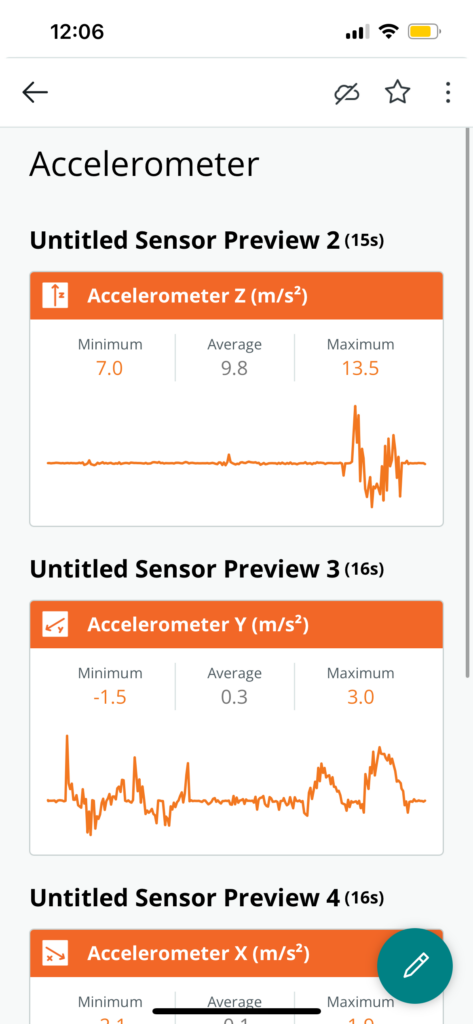
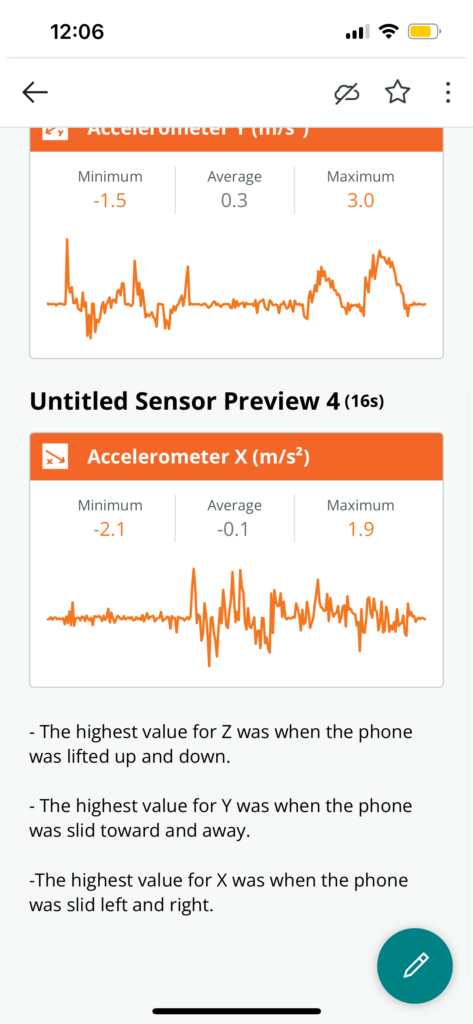
A great academic app that we tried out in class called Arduino Science Journal. This is a great way to help kids understand difficult scientific content such as acceleration. Below is the acceleration experiment I conducted using the app on my phone. It was really interesting to see how different movement was represented on a graph. I would definitely use this app with my class in the future. It was easy to navigate and fun to use!